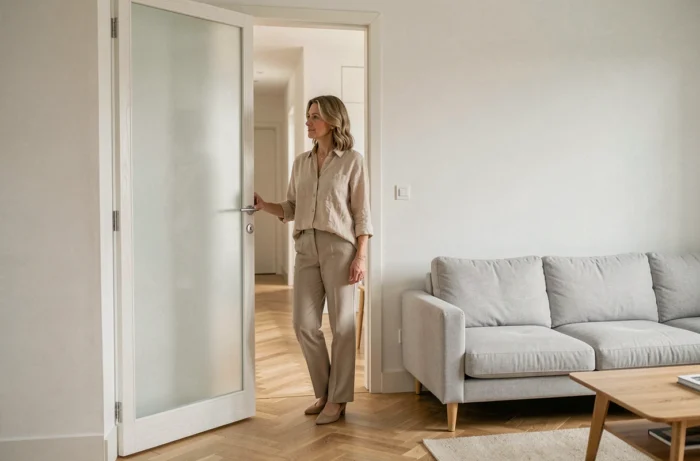
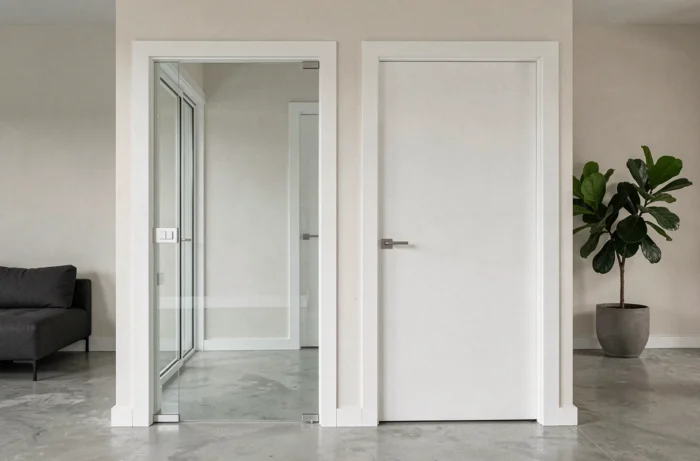
Between a glass swinging door and a solid door for a living room, the choice involves much more than just appearance. Light transmission, acoustic insulation, glass security, feeling of space: each criterion weighs differently depending on the configuration of the home. Comparing these two options based on measurable parameters allows for a decision without relying solely on aesthetic preferences.
Glass door or solid door for a living room: comparative performance table
Before analyzing each criterion in detail, a synthetic comparison helps visualize the differences between the two types of interior doors.
| Criterion | Glass swinging door | Solid door |
|---|---|---|
| Light transmission | High (clear glass) to moderate (frosted or ribbed glass) | None |
| Acoustic insulation | Moderate, depends on the type of glazing and the door frame | Superior, especially with solid wood or composite core |
| Visual privacy | Low (clear glass) to good (textured glass) | Total |
| Safety in case of impact | Requires safety glazing (laminated) according to NF DTU 39 standard | No specific constraints related to glazing |
| Feeling of space | Visually enlarges the room | Clearly defines volumes |
| Maintenance | Regular cleaning of glass surfaces | Minimal maintenance |
This table highlights a clear gap on two axes: light and acoustic insulation. The rest largely depends on the type of glazing chosen and the material of the solid door.
A detailed guide on the subject of swinging or solid doors on Atypik Home develops these parameters according to room configurations.
Safety glazing and NF DTU 39 standard: a technical constraint not to be ignored
Competitors rarely mention the regulatory framework that applies to interior glass doors. The safety memo FD DTU 39 P5 mandates the use of safety glazing for any glazed partition separating frequented spaces. Specifically, a glass swinging door installed between a living room and a hallway or kitchen must incorporate laminated glass, not just annealed glass.
Laminated glass consists of two sheets of glass bonded to an interlayer film. In case of impact, the shards remain attached to the film instead of dispersing. This requirement protects occupants, especially children.
Installing a glass door with non-compliant glass exposes one to a risk of injury and, in a co-ownership or in case of a disaster, to a refusal of coverage by insurance. Checking the compliance of the glazing at the time of purchase remains the simplest precaution.

Acoustic insulation between living room and adjacent rooms: the real gap between glass and solid
Acoustic insulation often constitutes the decisive argument in favor of the solid door. A solid core door made of solid wood or composite offers significantly better sound attenuation than a standard glass door.
However, the gap narrows when the glass door incorporates double glazing or acoustic laminated glazing. The door frame also plays a crucial role: a peripheral seal and a Swiss threshold improve insulation regardless of the type of door.
- Solid door with honeycomb core: limited acoustic attenuation, comparable to a simple glass door. The honeycomb core is lightweight, thus less effective than a solid core.
- Solid door with solid core (wood, high-density MDF): better acoustic performance, suitable for living rooms opening onto a hallway leading to bedrooms.
- Glass door with laminated glazing: intermediate performance, sufficient if the living room is not adjacent to a bedroom.
The choice therefore depends less on the type of door than on the composition of the door frame. A low-end solid door with a honeycomb core sometimes insulates less well than a glass door equipped with laminated glazing and quality seals.
Textured glazing and trends 2026: reconciling light and privacy in the living room
The classic criticism of the glass door in a living room is the lack of privacy. Ribbed, frosted, or slightly tinted glazing directly addresses this issue. In recent years, the trend has shifted away from the all-black industrial look towards finer structures, soft colors, and textured glazing.
A ribbed glazing allows light to pass while blurring silhouettes. Frosted glass offers an even more opaque filter. These solutions allow for natural lighting of a dark hallway or entrance without sacrificing the visual comfort of the living room.
This evolution changes the game for open living spaces. A glass swinging door with textured glass serves two functions: it transmits natural light and filters views, where one previously had to choose between the two.
What type of glazing for what use in the living room
Clear glass is suitable when the door separates the living room from a passage room (entrance, hallway). Frosted or ribbed glass is necessary as soon as the door leads to an open kitchen or workspace. Tinted glass adds a decorative touch but reduces light transmission.
Frame materials and dimensions: wood, aluminum, or mixed
The material of the frame influences durability, insulation, and overall style. Wood remains the most common choice for interior doors: it is easy to work with, accepts all finishes, and offers good thermal insulation.
Aluminum, being thinner, increases the glazed area in a glass swinging door. It is suitable for large openings where the frame needs to remain discreet. In return, aluminum conducts cold and noise more than wood.
Standard dimensions (204 x 73 cm, 204 x 83 cm) cover most living room openings. For renovations with non-standard frames, custom doors in wood or mixed wood-aluminum offer the necessary flexibility without compromising insulation.
The determining criterion for a living room is neither light alone nor insulation alone, but the balance between the two, adjusted to the room layout and adjacent spaces. A solid door with a solid core protects the acoustic comfort of a living room close to bedrooms. A glass door with textured glazing that complies with the NF DTU 39 standard brings brightness without sacrificing safety. The door frame, its seals, and its threshold are as important as the panel itself.