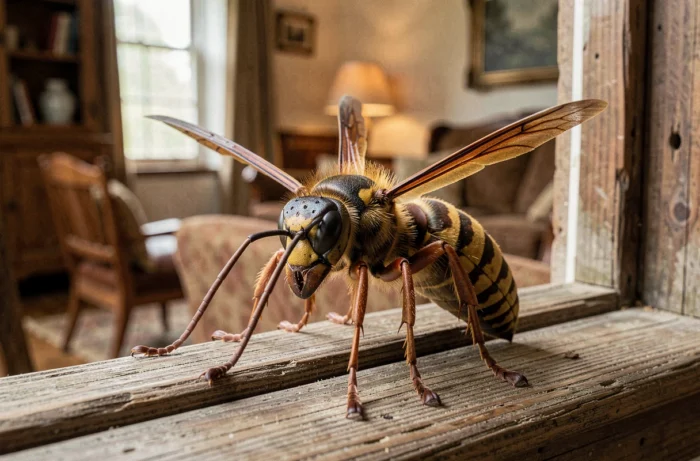
A hornet entering a living space often triggers an instinctive reaction of retreat. Beyond the surprise, some traditions attribute to this imposing insect a symbolic significance related to protection, vigilance, and transformation. Understanding these interpretations requires laying some groundwork about the hornet itself, the interpretative frameworks associated with it, and what distinguishes a sign from mere entomological coincidence.
European hornet and Asian hornet: two insects, two interpretations
Before attributing a spiritual meaning to the visit of a hornet, a practical distinction must be made. The European hornet (Vespa crabro) can fly after nightfall and may be attracted to lights or illuminated windows. The Asian hornet (Vespa velutina), on the other hand, is described as diurnal and generally builds its nest high up, outside.
These different behaviors change the way an intrusion is interpreted. A European hornet entering a living room on a summer evening is likely following a light source. An isolated individual does not mean that a nest is located in the house: it is repeated passages in the same area that justify searching for an entry point or a nearby colony.
French regulations have evolved with law n° 2025-237 of March 14, 2025, which specifically concerns the fight against the Asian hornet, classified as an invasive exotic species. The European hornet, however, remains a local species whose presence falls under a different category, both practically and symbolically. Those looking to deepen the spiritual significance of the hornet in the house will benefit from starting by identifying the species in question.

Symbolism of the hornet: vigilance, territory, and directed strength
In several spiritual traditions, the hornet is not just a pest. It embodies a precise energy, distinct from that of the bee or the wasp.
Protection of personal space
The hornet defends its nest with an intensity proportional to the perceived threat. This characteristic has fueled a symbolic reading centered on the defense of personal boundaries. Seeing a hornet enter one’s home would, within this framework, be an invitation to examine whether one is adequately protecting their space, resources, or energy.
This is not about gratuitous aggression. The European hornet, contrary to its reputation, is described as being not very aggressive even when one is near its nest. The strength it represents is that of a measured response, activated only when the situation demands it.
Intentional action
The hornet does not waste its resources. Every flight, every intervention in the colony responds to a concrete need. Traditions that associate it with the spiritual warrior (notably in some Asian cultures) emphasize this capacity for targeted action. The message attributed to the hornet is not “act more,” but rather “act with precision.”
Cyclical renewal
Every year, hornets abandon their old nest to build a new one. This biological behavior feeds a symbolism of transformation:
- Letting go of what no longer works, whether it be a habit, a relationship, or a project that has become sterile
- Accepting reconstruction as a normal process, not as a failure
- Recognizing that renewal sometimes requires the voluntary abandonment of an acquired asset

Hornet in the house: context of appearance and interpretation
All traditions that attribute a spiritual meaning to animals emphasize one point: context matters as much as the animal itself. A hornet encountered in the forest does not carry the same symbolic weight as a hornet that has entered a bedroom.
The house represents the intimate space, the refuge. An insect that enters it crosses a boundary. In symbolic interpretative frameworks, this intrusion can be interpreted in several ways depending on the circumstances:
- A hornet entering at night, attracted by light, conveys the idea of being guided by something visible but perhaps deceptive
- A hornet present repeatedly in the same spot suggests a recurring issue that one is pushing away without addressing
- A hornet found dead in the house is sometimes read as the end of a cycle of tension or conflict
- A hornet observed in a dream within a domestic space is associated, in some traditions, with a warning regarding a perceived but unidentified threat
These interpretations do not fall under an exact science. They constitute frameworks for personal reflection, not diagnoses.
Hornet as a totem animal: discipline and collective structure
In shamanic and neo-shamanic approaches, the totem animal designates an animal archetype whose qualities resonate with a person’s journey. The hornet, when identified as a totem, carries specific attributes.
The first is collective discipline. The hornet colony operates with a strict division of roles. This totem speaks to those who need to structure their environment, organize a project, or clarify responsibilities within a group.
The second is courage in the face of disproportion. The hornet can confront adversaries much larger than itself. As a totem, it invites one not to back down from an obstacle simply because it seems disproportionate.
The third is patient construction. A hornet’s nest is a complex architecture, built fiber by fiber. The hornet totem reminds us that lasting results come from methodical work, not from a one-time burst of energy.
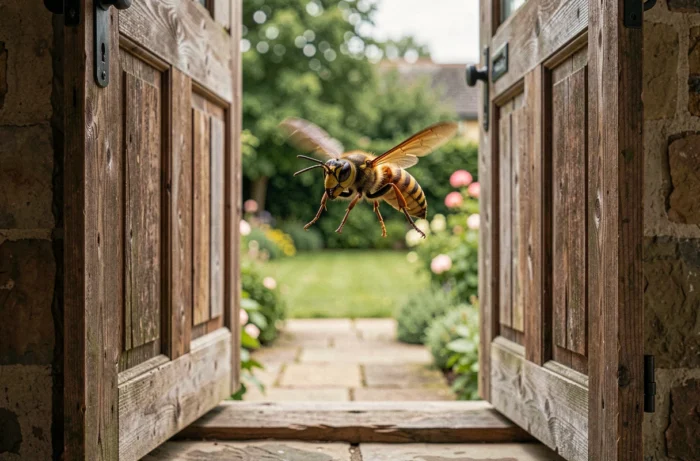
The presence of a hornet in a house may have a purely behavioral explanation: light, warmth, or accessible cavity. It can also be viewed through a symbolic lens. The two approaches are not mutually exclusive.
One can involve a professional to check for the absence of a nest while taking the time to reflect on what this visit resonates with. The hornet does not provide ready-made answers: it poses a question about how one defends, builds, and renews what matters.