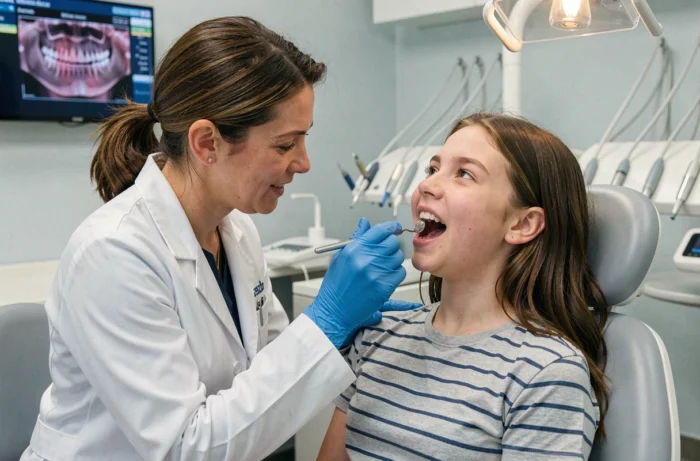
Dentofacial orthopedics is about more than just straightening teeth. It addresses the underlying skeletal structures, the relationship between the dental arches and orofacial functions to restore a balance that orthodontics alone cannot achieve. Understanding the diagnostic principles behind dentofacial orthopedics helps explain why an early assessment does not always lead to braces.
Dentofacial orthopedics assessment: cephalometry as a treatment-planning tool
A dentofacial orthopedics assessment is based on cephalometric analysis, which measures skeletal relationships in three dimensions. Lateral cephalometric radiographs are used to measure the SNA, SNB and ANB angles, characterizing the position of the maxilla and mandible relative to the cranial base. These values guide the diagnosis of a skeletal Class I, II or III and inform the choice between orthopedic, orthodontic or surgical treatment.
The analysis is not limited to the sagittal plane. The vertical dimension (hyperdivergence or hypodivergence) can radically alter the prognosis and the treatment mechanics available. A hyperdivergent patient with a skeletal Class II is not treated in the same way as a hypodivergent patient with the same classification.
To learn more about dentofacial orthopedics in orthodontics, this three-dimensional view of the facial skeleton needs to be incorporated into clinical reasoning well before choosing an appliance.
The practitioner combines cephalometric data with a clinical assessment of function, including breathing, swallowing and tongue posture. Chronic mouth breathing, for example, can contribute to transverse maxillary deficiency, which an appliance alone will not correct if the underlying functional cause persists.
Early orthodontic assessment in children: when observation takes the place of an appliance
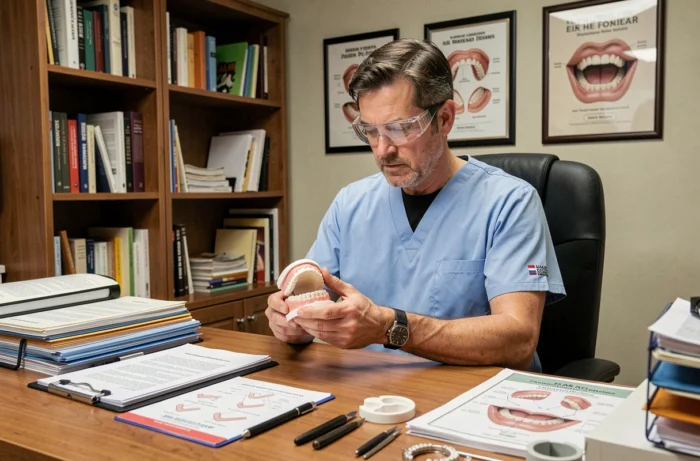
An initial assessment can be carried out from the age of six, during the mixed dentition stage. Screening aims to identify skeletal discrepancies while growth still allows room for orthopedic intervention.
An early assessment does not mean immediate treatment. The practitioner may decide that monitoring alone is sufficient, with a follow-up appointment in early adolescence to reassess the situation as the bones mature.
Active monitoring and criteria for starting treatment
Three scenarios may arise after an early assessment:
- The problem is purely skeletal (maxillary constriction or early mandibular prognathism) and warrants prompt orthopedic intervention to make use of the remaining growth potential.
- The discrepancy is moderate and may be corrected naturally by the remaining growth. The practitioner schedules check-ups every six or twelve months without fitting an appliance.
- The problem is primarily dental (crowding or rotation), and treatment is postponed until the relevant permanent teeth have erupted.
Explaining this approach to families helps avoid confusion when an assessment does not lead to any immediate treatment. Observation is not inaction; it is a documented clinical decision. The practitioner monitors specific indicators (molar relationship, incisor overjet and facial symmetry) and starts treatment when the benefit-risk balance is right.
Orthopedic appliances and dentofacial orthopedics treatment mechanics
Orthopedic appliances act on the bone, not the teeth. This distinction determines the type of appliance used and the window in which it can be effective.
Functional appliances and orthopedic forces
Functional appliances (such as the Andresen activator and Bionator) redirect muscle forces to stimulate or restrain mandibular growth. Tooth-borne or bone-borne maxillary expanders apply a transverse force to the midpalatal suture to correct maxillary constriction. These appliances only work while the sutures remain open, which limits their effectiveness once growth is complete.
Extraoral appliances (such as occipital-pull headgear and the Delaire facemask) apply traction to the maxilla to correct skeletal Class III malocclusions caused by maxillary deficiency. Their effectiveness depends directly on patient compliance, so it is important to discuss daily wear time clearly with the family.

Moving from the orthopedic phase to the orthodontic phase
Dentofacial orthopedics treatment often takes place in two stages. The first corrects the skeletal discrepancy. The second, orthodontic stage, aligns the teeth on the now-harmonized skeletal bases. A period of retention or monitoring between the two stages helps consolidate the orthopedic results.
Post-orthopedic retention stabilizes the skeletal result before leveling and alignment mechanics begin. Without this step, the risk of the skeletal discrepancy recurring increases, compromising the stability of the final result.
Financial coverage and prior approval before age sixteen
Coverage by the French Health Insurance system requires treatment to begin before the patient’s sixteenth birthday. A prior approval request is sent to the health insurance fund along with diagnostic records (dental casts, X-rays and photographs).
Orthodontists set their own fees. An itemized estimate details the total cost of treatment, the amount reimbursed by the French Social Security system and any remaining out-of-pocket costs. For treatment started after age sixteen, no standard coverage is available, except in specific cases involving orthognathic surgery.
This administrative requirement makes early screening especially valuable: in addition to its clinical benefits, consulting a practitioner before early adolescence preserves access to reimbursement if treatment proves necessary.