
You have an opened can of outdoor wood varnish and a living room piece of furniture to protect. Using this leftover product seems logical. Outdoor varnish is known to be more resistant, harder, and more protective. Applying outdoor wood varnish indoors is technically possible, but this simple idea raises questions about health, finish, and, recently, European regulations.
Formaldehyde Emissions: What the REACH Regulation Changes for Indoor Varnish Use
Most guides compare varnishes based on their hardness or UV resistance. Few address a topic that is becoming central: chemical emissions in the air of your home.
The European REACH regulation introduced a new entry in 2023 (Regulation (EU) 2023/1464, entry 77) that sets formaldehyde emission limits for furniture and wooden articles intended for indoor use. These limits will apply from August 6, 2026, for most products.
In practical terms, a wooden piece of furniture used indoors must not exceed 0.062 mg/m³ of formaldehyde measured in a test chamber. For other items intended for indoor use, the limit is set at 0.080 mg/m³. Items exclusively intended for outdoor use are explicitly excluded from this framework.
Why does this concern you? A varnish formulated for outdoor use was not designed to meet these emission thresholds in enclosed spaces. If you apply it to a kitchen table or a bookshelf, the final item falls within the scope of indoor emission limits. In the event of resale or inspection, the compliance of the furniture could be questioned.
Before reusing outdoor varnish on indoor furniture, it may be helpful to varnish outdoor wood with Bazardons to better understand the technical implications of this choice.
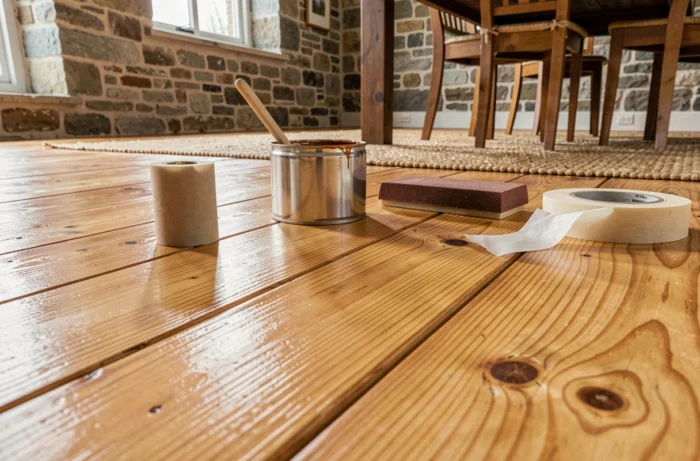
Outdoor Varnish Applied Indoors: What Works and What Doesn’t
An outdoor wood varnish contains harder resins and UV filters. These properties are not useless indoors, but they do not always result in a better finish.
The Real Advantages
Mechanical resistance is the main advantage. An outdoor varnish forms a dense protective film, often thicker than a standard indoor varnish. On a heavily used surface (a countertop, a child’s furniture), this extra hardness can limit scratches.
UV filters protect the wood from yellowing if the furniture is placed near a sun-exposed window. A standard indoor varnish does not always contain these filters.
The Concrete Disadvantages
- The odor is significantly stronger and lasts longer. Outdoor varnishes, especially solvent-based versions, contain volatile organic compounds (VOCs) in higher quantities than a water-based indoor varnish. In a closed room, the drying and airing time is considerably extended.
- The aesthetic result differs. Outdoor varnishes rarely offer refined satin or matte finishes. Most are designed for a functional, not decorative, appearance. On a living room piece of furniture or woodwork, the film may appear thick, plastic-like, or even slightly yellow.
- Long-term maintenance poses a problem. An outdoor varnish, designed to withstand the elements, reacts differently to domestic wear. Indoors, it does not chip due to rain but may micro-crack from repeated friction (chairs, drawers). Sanding for touch-ups is then more difficult than with a standard indoor product.
Water-Based or Solvent-Based Varnish: The Decisive Criterion for Indoor Use
If you still decide to use outdoor varnish indoors, the type of solvent radically changes the experience.
A water-based varnish emits fewer VOCs. Tool cleaning is done with water, the odor is moderate, and drying between coats is faster. For indoor use, a water-based outdoor varnish remains the least risky compromise.
A solvent-based varnish offers superior hardness and better moisture resistance. However, its application indoors requires sustained ventilation for several days. In a bedroom or poorly ventilated space, this choice is not recommended.
Have you ever noticed that persistent odor after varnishing a piece of furniture in a closed room? With a solvent-based outdoor product, it can last much longer than with a standard indoor varnish.
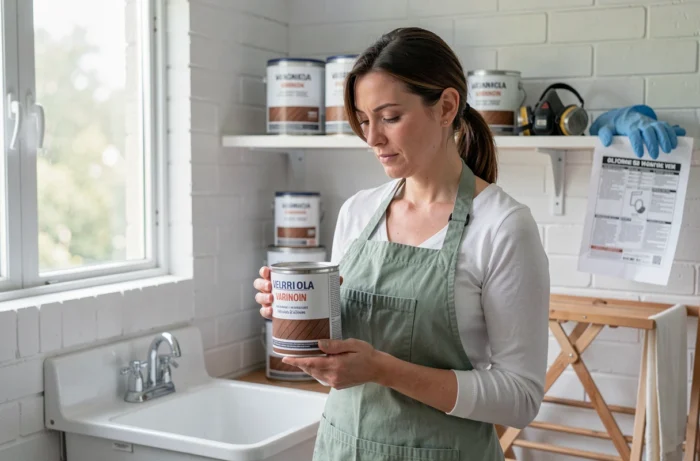
When to Prefer a Standard Indoor Varnish or an Alternative
The idea of reusing leftover outdoor varnish is understandable. However, in most cases, a product designed for indoors will yield better results.
An indoor varnish is formulated for quick drying, low odor, and a finish suitable for furniture and woodwork. The available finishes (matte, satin, glossy) are more varied. Sanding between coats is simpler, and touch-ups after a few years of wear can be done without heavy stripping.
For a teak piece of furniture or a table subjected to frequent water splashes (bathroom, kitchen), the question arises more acutely. In this specific case, a water-based outdoor varnish may be justified, provided that a prolonged drying time is respected and the room is ventilated.
If protecting the wood from moisture is your priority, other products deserve consideration:
- Stain, which penetrates the wood without forming a surface film and allows the fiber to breathe
- Hard oil, which nourishes the wood deeply and can be easily renewed by simple local application
- Saturator, designed to impregnate without creating a film-forming layer, thus avoiding flaking issues
These alternatives provide effective protection without the emission and odor constraints of an outdoor varnish repurposed from its intended use.
An outdoor varnish on indoor furniture will not damage the wood. The risk lies elsewhere: in the air you breathe, in the finish that does not meet your expectations, and soon in a regulatory framework that clearly distinguishes products based on their intended use. Checking the product’s technical data sheet and its VOC content remains the most reliable reflex before any application in an enclosed space.