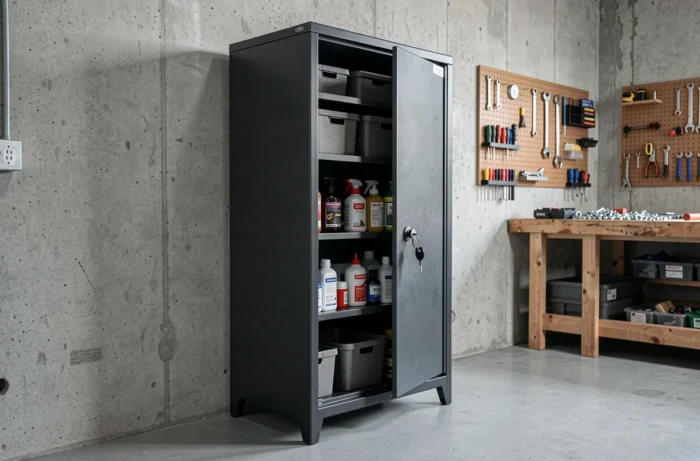
Storing a shotgun at home is not just about finding a locked cupboard. French regulations require an appropriate security device, and the choice of furniture depends as much on your current arsenal as on your ammunition. Brico Dépôt offers several models of safes, but not all meet the same needs. Here’s how to sort through them without making a mistake.
Ammunition quotas and storage volume: the criterion that no one sizes up
As of January 1, 2024, a decree from July 3, 2023 sets a maximum quota of 1,000 rounds per category B firearm, with an annual acquisition right raised to 3,000 rounds per weapon. This change directly impacts your choice of safe.
Why? Because ammunition must be stored in a separate compartment, equipped with its own lock. With higher quotas than before, the volume of ammunition to secure mechanically increases. A safe designed for five rifles but with a tiny internal compartment will no longer suffice if you own multiple category B firearms.
Before looking at the number of rifle slots, estimate the volume of ammunition you actually store over a year. If you choose a rifle safe at Brico Dépôt, ensure that the ammunition compartment is deep enough to hold several stacked boxes, or plan for a separate dedicated safe.
Steel thickness and lock type: what distinguishes a reliable safe
You may have noticed that two safes at the same price can offer very different levels of protection? The difference lies in two specific technical points.
Sheet thickness
A rifle safe from a DIY superstore typically uses cold-rolled steel. The minimum recommended thickness is around 2 mm for the walls, and more for the door. Below this, a crowbar is enough to force it open in a few minutes. Check this information on the product sheet before any purchase.
Key lock or code lock
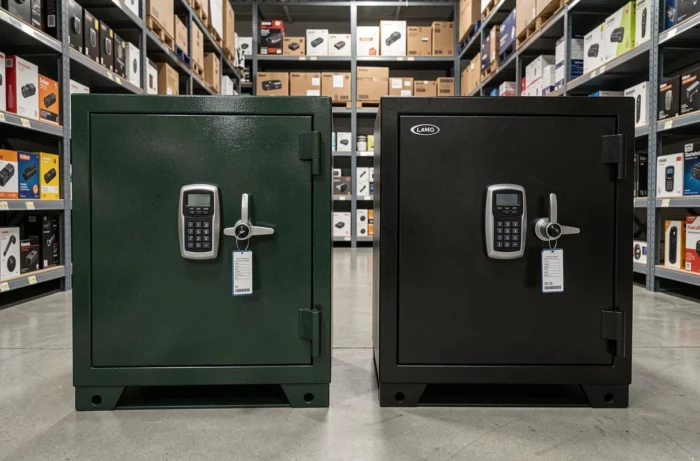
Entry-level models are often equipped with a simple key lock. It’s functional, but it also means securing the key (which is implicitly expected by regulations). Models with electronic code locks eliminate this problem: no key to lose, no duplicate to hide.
Some models combine both systems. This is a real advantage if you share access with another authorized holder, as you can provide the code without duplicating a physical key.
- Key lock: reliable, inexpensive, but the key becomes a vulnerability point if misplaced.
- Electronic code lock: more practical for everyday use, requires regular battery replacement to avoid access failure.
- Dual key + code system: the best compromise for households with multiple declared shooters.
Wall or floor mounting: a step often rushed
Buying a compliant safe is pointless if it is not properly secured. An unsecured safe can be taken whole during a burglary, and you then lose all legal protection.
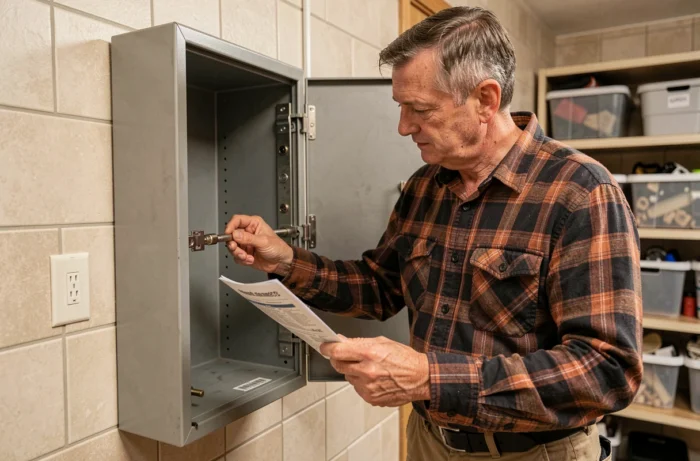
Most safes sold in DIY superstores come with a mounting kit (anchors, concrete screws). The principle is simple: at least two anchoring points, ideally on the floor and the wall. On a cinder block or concrete wall, it’s quick. On drywall, you need to go through the partition to reach the load-bearing structure, or only secure it to the floor on a concrete slab.
Where to install the safe in the house
Prefer a room without a window facing outside, or whose window is not visible from the street. A garage, pantry, or laundry room are suitable. Avoid upstairs bedrooms if the floor is wooden: the weight of a loaded safe often exceeds a hundred kilos, and old joists are not always sized for that.
Post-burglary check: what poorly equipped holders risk
In the event of a weapon theft, law enforcement systematically checks the storage conditions at the holder’s home. If the safe does not comply with current standards, or if it was not secured, you expose yourself to sanctions that go beyond the simple loss of the stolen weapons.
The main risk is the loss of your possession authorization. Post-burglary checks have intensified in recent years, and insufficient storage can lead to administrative withdrawal. This means that even if your weapons are recovered, they will not be returned to you if your setup is non-compliant.
- Unsecured safe: considered insufficient by the administration, even if certified.
- Ammunition stored with weapons without separation: a clear violation, even in a certified safe.
- Total absence of a secure device: risk of criminal prosecution in addition to withdrawal of authorization.
This point deserves to be considered from the moment of purchase. A low-priced safe without certification or possible mounting amounts, in case of a problem, to not having a safe at all.
The choice of a rifle safe is based on three concrete criteria: a volume suitable for both ammunition and weapons, a steel thickness and locking mechanism that withstands an attempted break-in, and a solid mounting on a load-bearing support. At Brico Dépôt, the models meet these needs as long as you read the technical sheets beyond just the number of rifles displayed in the showcase.