
Organizing a unique wedding involves choosing where to invest your energy and budget. Between the venue, the meal, the decoration, and the entertainment, not all expense categories have the same impact on the guests’ experience. Comparing these originality levers allows you to identify those that truly transform a reception without inflating the bill.
Controllable venue or all-inclusive hall: what each format changes concretely
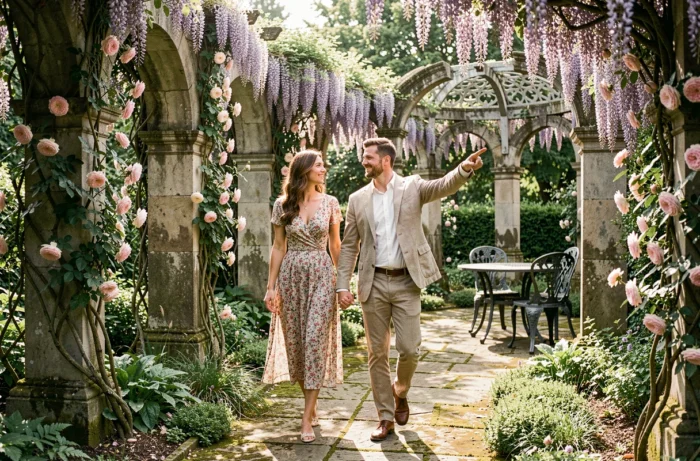
The current trend pushes couples towards historical properties or country houses where they control the entire scenography: furniture, catering, lighting. This choice opens up the possibility of building a visual identity linked to the territory and the season, whereas an all-inclusive reception hall imposes a standardized framework.
| Criterion | Controllable venue (private estate, country house) | All-inclusive hall (hotel, packaged estate) |
|---|---|---|
| Scenography | Free: choice of furniture, fabrics, lighting | Imposed or limited to the provider’s catalog |
| Catering | External, selected by the couple | Often imposed or recommended |
| Logistical burden | High: coordination, deliveries, setup | Low: the venue manages most aspects |
| Potential for originality | Strong: each wedding can be visually different | Moderate: variation of an existing framework |
| Budget risk | Variable: hidden costs (electricity, toilets, parking) add up | More predictable due to the package |
The controllable venue requires more preparation time, but it remains the most powerful lever for creating a wedding that looks unlike any other. To find ideas on Univers Mariage, couples can spot decorative elements adaptable to any space, making it easier to personalize a raw venue.
Food waste at the wedding meal: an underestimated angle of originality
The meal represents one of the heaviest items in a reception budget. It is also where waste reaches significant levels. Providers now offer real-time menu adjustments, options for recovering leftovers, and doggy bag-style formulas.
This lever changes the game on two levels. It reduces the final bill by adjusting quantities. It also provides coherence to the wedding for couples sensitive to environmental issues, without resorting to costly symbolic gestures.
- Adjust the quantities ordered from the caterer based on attendance confirmations received in the last week, rather than relying on the initial number of invitations sent
- Provide reusable containers for guests to take home surplus from the buffet or dessert
- Choose a caterer that offers a modular menu with integrated vegetarian options, which limits uneaten dishes for guests with specific diets
This approach costs nothing extra. It simply requires an honest discussion with the caterer in advance and precise tracking of the confirmed guest list.
Number of guests and budget per person: the real trade-off
Couples tend to reduce the number of guests to allocate more budget to the experience of each individual. This shift is linked to the fact that a growing share of couples finance their own wedding, rather than relying on parental support.
Reducing the guest list by twenty or thirty people frees up a budget that can shift towards a more unique venue, a higher quality meal, or a memorable entertainment option. On the other hand, a small wedding changes the atmosphere of the evening: the dance floor fills differently, and group games function differently.
What the small committee format allows
A seated meal with dishes prepared on-site by a chef becomes accessible when the guest count drops below fifty. Personalized secular ceremonies also gain intensity with a smaller audience, as each person present has a strong connection to the couple.
The small committee format allows for venues that would be impossible on a larger scale: a Michelin-starred restaurant, a private apartment, a family garden. The number of guests determines the range of possibilities much more than the gross budget.

Decoration and ceremony: where originality produces a real effect
Competitors often list dozens of decorative ideas without hierarchy. Not all have the same impact perceived by guests. Careful lighting transforms any space. Rare flowers on the tables, on the other hand, often go unnoticed beyond the first hour.
The elements that leave a lasting impression on guests are those that change the overall atmosphere:
- Lighting (string lights, candles, colored spotlights) changes the perception of the entire venue for a controlled cost
- Music and its sequencing shape the energy of the evening, from the ceremony to the last song
- A personalized secular ceremony ritual (tied hands, tree planting, reading of vows) creates an emotional memory that decoration alone does not produce
- The choice of paper and design for the invitations sets the tone even before the big day
Investing in the overall scenography rather than in isolated decorative details produces a more coherent effect. A wedding where the lighting, music, and ceremony tell the same story remains etched in memories, even with simple centerpieces.
The Pinterest wedding trap
Accumulating visual ideas without a guiding thread results in a reception that resembles a catalog. Couples who start from a personal narrative (their meeting, a trip, a significant place) achieve a coherence that guests immediately perceive, even if they can’t always explain it.
Weddings in France are experiencing a recent resurgence after several disrupted years. This recovery comes with stronger expectations for personalization. Focusing on three or four structuring choices (venue, meal format, ceremony, lighting ambiance) yields a more striking result than spreading the budget over a long list of decorative touches. The most lasting originality may not always be visible in photos: it is felt in the experience lived by each guest present.