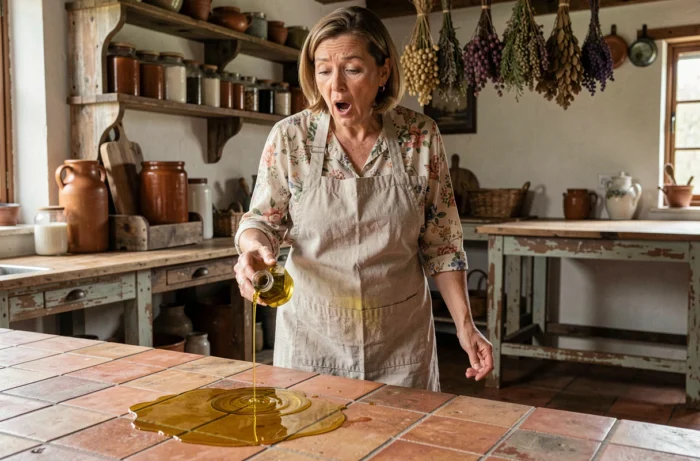
Spilling oil on the ground triggers, depending on the region of the world, a worried grimace or an amused shrug. Superstition exists in the Mediterranean basin, the Balkans, the Middle East, and the Caribbean, but its interpretation varies to the point of contradicting from one country to another. Comparing these beliefs allows us to measure how the same domestic gesture can carry opposing meanings.
Superstitions related to spilling oil: comparative table by region
| Region or country | Interpretation of spilling oil | Traditional reparative gesture |
|---|---|---|
| Italy (south, Apulia) | Bad omen, prolonged bad luck (sometimes associated with a duration of seven years) | Throwing a pinch of salt over the left shoulder |
| Greece | Ambivalent: bad omen at the table, but a medieval proverb compares spilling oil to a false catastrophe that resolves well | Placing the salt shaker on the table instead of passing it hand to hand (practical rationalization) |
| Balkans (Serbia, Croatia) | Spilling salt brings bad luck, oil is sometimes included in the same belief | Salt thrown over the shoulder |
| Caribbean (Guadeloupe, Martinique) | Sign of an imbalance in the immediate environment, associated with domestic misfortune | Ritual cleaning, sometimes accompanied by a prayer |
| Kuwait and Gulf | Spilling liquid at the table seen as a warning, severity varies | Protective invocation |
This table highlights a rarely emphasized point: spilled oil does not mean the same thing from one shore of the Mediterranean to another. In Southern Italy, the fear of bad luck dominates. In Greece, a medieval proverb relativizes the significance of the gesture by presenting it as a disproportionate alarm compared to the actual damage.
To delve deeper into the meaning of spilling oil on the ground in its mystical and cultural dimensions, several traditions offer complementary frameworks for understanding.
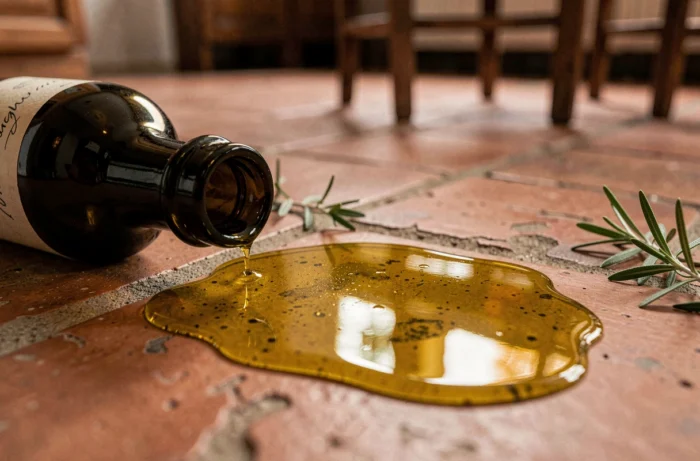
Origin of superstitions around oil: why this specific liquid
Olive oil held a central place in ancient domestic economy. It served as fuel for lamps, a food base, a cosmetic product, and a ritual ointment. Spilling oil amounted to wasting a rare and costly resource, which is enough to explain the emotional weight of the gesture.
In Abrahamic traditions, oil is also the vector of sacred anointing. A king, priest, or prophet would receive oil on the forehead as a sign of consecration. Dropping this substance on the ground could thus be interpreted as an affront to the sacred, a symbolic rupture between the divine and the everyday.
From domestic waste to spiritual omen
The transition from economic explanation to superstitious interpretation occurred gradually. Contemporary Greek media increasingly emphasize the practical dimension behind these beliefs: placing the salt shaker on the table instead of passing it hand to hand reduces the risk of spilling. Superstition thus served as a rule of domestic caution dressed in a mystical narrative.
This mechanism of rationalization after the fact is not unique to oil. Spilled salt, broken mirrors, and bread placed upside down follow the same pattern: a domestic accident associated with a material or symbolic cost transforms into a superstitious taboo.
Contradictory beliefs: misfortune or false alarm
The most striking divergence concerns Greece. While most Mediterranean cultures see spilling oil as a sign of bad luck, a medieval Greek proverb uses the image of spilled oil to denote a situation that seems catastrophic but ends well. Oil on the ground thus becomes the symbol of an unjustified fear, not of real misfortune.
In Italy, on the other hand, the belief remains firmly rooted in the negative register. In Apulia, local mystical practices include specific protective gestures after spilling oil, sometimes accompanied by prayers or signs of the cross. The duration of bad luck associated with the gesture can reach seven years, mirroring the superstition of the broken mirror.
Salt and oil: two superstitions that overlap
In the Balkans and southern Italy, superstitions related to salt and oil often overlap. The reparative gesture is the same: throwing salt over the left shoulder, which is supposed to be the devil’s side. This fusion of two distinct beliefs blurs interpretation.
- Spilled salt is almost universally perceived as a bad omen in Mediterranean and Balkan Europe
- Spilled oil often inherits the same negative charge by association, without a clearly documented tradition of its own in certain regions
- The gesture of throwing salt over the left shoulder has been attested since the Middle Ages and may find its origin in the representation of Judas spilling a salt shaker during the Last Supper

Superstition and health risk: the modern dimension of spilled oil
Recent health alerts regarding batches of olive oil contaminated with mineral oils add an unexpected layer to the question. European authorities have ordered the recall of Italian products suspected of containing undesirable substances. “Bad” oil is no longer just a symbolic bad sign, but an identified health risk.
This shift is significant. In a context where consumers voluntarily discard oil deemed unfit, the gesture of “spilling” or getting rid of oil moves from the superstitious realm to that of food precaution. The boundary between belief and rational caution, already porous in Greek folklore, becomes even blurrier.
When superstition meets practical reason
The parallel between the Greek rationalization of domestic superstitions and contemporary health recalls draws a connecting thread: in both cases, a behavior of caution (not wasting, not consuming a questionable product) translates into a particular relationship with oil on the ground. Superstition has codified in mystical narrative what health reason formulates today in press releases.
- In Greece, the superstition of spilling is increasingly presented as a rationalization of gestures aimed at avoiding domestic accidents
- Recent health recalls on contaminated olive oil provide a concrete justification for distrust of “falling” oil
- The boundary between precaution and superstition remains thin, with each era dressing the same caution in different vocabulary
Spilling oil on the ground remains one of the few superstitions whose interpretation changes radically depending on longitude. The same gesture brings bad luck in Bari, makes one smile in Athens, and triggers a ritual cleaning in Guadeloupe. What connects them all is the status of oil as a precious resource whose loss, real or symbolic, leaves no one indifferent.