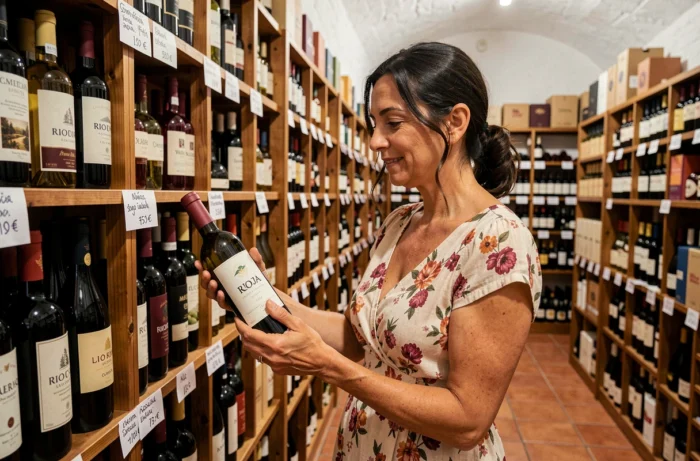
Every summer, thousands of French cars cross the border to fill their trunks in La Jonquera or at Perthus. The promise has remained the same for years: to pay less for alcohol than in France. In 2026, the equation has changed on several points, and the calculation deserves to be redone before hitting the road.
Tax Gap France-Spain on Alcohol: What Maintains the Difference in 2026
Why is alcohol cheaper on the other side of the Pyrenees? The answer lies in two words: taxation and excise duties. Spain applies a reduced VAT on alcohol and does not levy any excise duty on wine. In France, the standard VAT applies, and excise duties increase the bill on spirits.
This tax mechanism has not changed in 2026. An article from Drinks Business published in August 2026 confirms that wine remains excise-free in Spain, Italy, and Germany. This structural foundation explains why bottles of Spanish wine remain at very low prices, even during inflationary periods.
For a detailed overview of prices in border shops, a recent analysis compares the alcohol prices in La Jonquera according to En Route pour l’Asie and provides a concrete idea of the differences by product category.
For spirits (vodka, gin, whisky), the price difference still exists, but it has narrowed. The price advantage is no longer uniform across categories. Larger formats and bulk purchases remain the most interesting. On a standard bottle of whisky with the same brand, the savings may seem modest once calculated per liter.
Spanish Inflation in 2026: The Silent Erosion of Good Deals
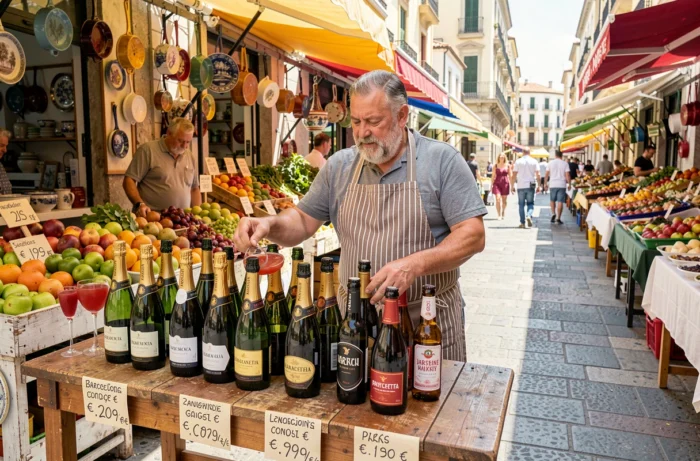
Have you noticed that prices in stores in La Jonquera have risen in recent months? It’s not just an impression. The Spanish National Statistics Institute (INE) published an annual inflation rate of 3.6% for July 2026 in August 2026. The category “alcoholic beverages and tobacco” shows an increase of 3.0%.
Specifically, the bottles you bought at a given price last year now cost a few cents to a few tens of cents more. This isn’t spectacular product by product. But multiplied by a full trunk, Spanish inflation eats away at part of the expected savings.
On the French side, inflation on alcoholic beverages follows its own trajectory. The price gap between the two countries is gradually narrowing, especially on beer and entry-level wine. Spirits hold up better because French taxation weighs more heavily.
Hidden Costs of the Border Trip: Tolls, Fuel, and Time
The classic mistake is to compare only the price on the label without factoring in the cost of the trip. For someone living in Perpignan, the journey to Perthus or La Jonquera incurs little expense. For someone coming from Toulouse, Montpellier, or Lyon, the situation changes.
Here are the factors to consider before concluding that the trip is worthwhile:
- The round-trip fuel cost, which obviously depends on the distance but also on the price of diesel or gasoline at the time of travel.
- The highway tolls, which can amount to several tens of euros depending on the starting point.
- The time spent on the road and in stores, which has value even if it is not always quantified.
- The wear and tear on the vehicle for an additional trip, often overlooked in the calculation.
Below a certain purchase volume, the trip costs more than the savings made. This break-even point depends on your place of residence and the types of products targeted.
Customs Quotas and Products Where Spain Remains Competitive
The quantities allowed by French customs for an individual returning from an EU country set a precise framework. For alcohol, the indicative thresholds are 10 liters of spirits and 90 liters of wine per adult. Beyond that, customs may consider the purchase to have a commercial purpose, with penalties involved.
These volumes are generous for personal use. Few individuals reach 90 liters of wine in a single trip. However, the limit on spirits is reached more quickly if you are buying for multiple households.
Categories Still Really Advantageous
Spanish wine remains the segment where the price gap most easily justifies the trip. Common appellations (wines from La Mancha, entry-level Rioja) are found at prices that French supermarkets cannot match, thanks to the absence of excise duty.
For spirits, large formats and bulk purchases remain the best lever for savings. A pack of twelve bottles of gin or vodka purchased at a Spanish border supermarket remains significantly cheaper than the same volume in France.
Local beer (Estrella Damm, Mahou) remains competitive, but the gap with French beers sold on promotion has narrowed. In this segment, the good deal depends more on timing than on the place of purchase.
Conclusion: Who Still Benefits from the Trip in 2026?
The answer depends on three variables: the distance to the border crossing point, the expected purchase volume, and the targeted product categories. A resident of Perpignan who buys wine in quantity still finds it worthwhile. A person from Lyon wanting to bring back a few bottles of whisky will likely find it a neutral operation, or even a loss once travel costs are accounted for.
Spain remains competitive on wine and spirits in large volumes, but the time when any border trip guaranteed substantial savings is fading. Spanish inflation, the narrowing of gaps on certain products, and the cost of travel necessitate an honest calculation before starting the engine.