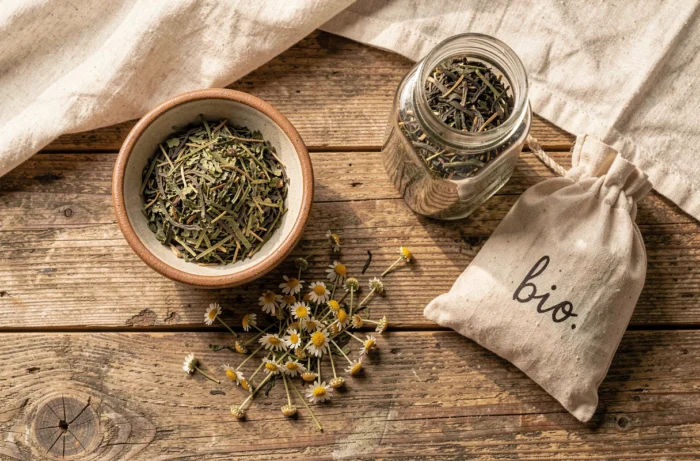
When you open a cupboard filled with bags and boxes of organic tea, the reflex is often to fall back on the same green tea or the same Earl Grey. The problem is that you miss out on entire categories of organic products that radically change the experience in the cup. Oxidized teas, herbal infusions, rooibos, spice blends: each family has its own tasting codes, conservation constraints, and purchasing pitfalls.
Pesticide residues and European regulations: what changes for organic tea in 2026
The European Parliament has tightened the maximum residue limits (MRLs) for several pesticides used in imported tea crops. For organic tea lovers, this development reinforces the quality gap between a certified product and a low-end conventional tea.
In practical terms, certified organic leaves must meet much lower residue thresholds than the new conventional MRLs. An AB or Euroleaf labeled tea prohibits the use of synthetic pesticides on the plot, and controls also focus on soils and irrigation waters.
Traceability is progressing in parallel. Several major exporters (India, Sri Lanka, China) now integrate batch traceability systems, from the high-altitude garden to the European packer. For us consumers, this means that we can check the exact origin of the batch on certain packaging, which was not common a few years ago.
The share of organic in the tea and infusion segment reached 19.6% in 2026, an increase of two points compared to the previous period. In France, the overall organic market has rebounded to 12.6 billion euros, with a growth of 3.6% compared to 2024. Organic tea directly benefits from this structural recovery.
For those who want to quickly identify the families of products available in organic, we can explore the sections of Le Jardin de Gaïa and see the extent of the categories offered by a specialized importer.
Green tea, black tea, white tea organic: how the level of oxidation guides the choice

All teas come from the same plant, Camellia sinensis. What distinguishes green tea from black tea is the degree of oxidation applied after picking. In organic, this transformation follows the same steps as in conventional, but without synthetic chemical aids.
Organic green tea: quick fixation and vegetal notes
The leaf is heated very quickly after harvest to stop oxidation. This results in vegetal notes, sometimes marine (Japanese teas) or roasted (Chinese wok teas). A quality organic green tea is recognized by the color of its infusion, which remains clear and bright, never cloudy or brownish.
Organic matcha, powdered shaded green tea, constitutes a separate sub-category. Its higher price is explained by cultivation under shade for several weeks before harvest, which concentrates amino acids in the leaf.
Organic black tea: complete oxidation and pronounced body
Here, the leaves are rolled and then oxidized until they develop malty, woody, or fruity aromas depending on the origin. Organic black teas from Assam or Ceylon offer a dense body, suitable for breakfast. Those from Darjeeling, picked at altitude, develop more floral flavors.
Organic white and oolong tea: the underestimated categories
White tea undergoes minimal and natural oxidation, simply by withering in the air. Its notes are sweet, sometimes honeyed. Oolong is situated between green and black, with partial oxidation that can vary significantly from one producer to another. Feedback varies on this point: some organic oolongs remind of a floral green tea, while others are closer to a light black.
Organic infusions, rooibos, and herbal teas: beyond Camellia sinensis
When we talk about “tea” in everyday language, we often include beverages that contain no tea leaves at all. This is the case with rooibos, herbal teas, and fruity infusions. In organic, these products represent a growing share of the market.
- Organic rooibos: South African shrub naturally caffeine-free. Its notes are round, slightly sweet. It blends well with spices (cinnamon, ginger) or citrus.
- Organic herbal teas: mint, verbena, chamomile, hibiscus, but also more specialized blends (sage, lemon balm, tulsi). The key criterion is the quality of drying, which preserves the volatile oils responsible for flavor.
- Organic fruity infusions: blends of dried fruit pieces, peels, and flowers. They contain neither caffeine nor theine and offer indulgent, often tangy flavors.
For these categories, the mention “organic” guarantees the absence of post-harvest treatments such as irradiation or synthetic preservatives, two practices still allowed in conventional in some exporting countries.

Flavored organic teas and spice blends: read the ingredient list
An organic Earl Grey uses significant certified bergamot oil, not a synthetic flavor. An organic chai mixes spices (cardamom, clove, black pepper) with a base black tea, without flavor enhancers. The difference is felt directly in the cup: the flavors are less uniform, more complex.
A common pitfall concerns the mention “natural flavors.” In organic, the flavors must come from the named raw material, but regulations allow for some latitude. An organic tea “mango flavor” can contain a natural mango flavor without the whole fruit being present. Checking the complete ingredient list remains the most reliable action.
- Organic spiced teas: chai blends, green tea with ginger, black tea with cinnamon. Ensure that the spices are also certified organic.
- Organic floral teas: jasmine, rose, osmanthus. The best lots are scented by direct contact with fresh flowers, not by the addition of flavor.
- Organic citrus teas: bergamot, lemon, yuzu. Prefer blends that include dried peels rather than just a flavor.
The offer of organic teas and infusions has been structured in recent years around well-defined categories, each with its own quality criteria. Rather than randomly multiplying purchases, identifying the product family that corresponds to one’s tasting habits (time of day, tolerance to caffeine, preference for vegetal or spicy notes) remains the most direct method to take advantage of this diversity.